Cracked Pickleballs: How to Spot One and Why to Pull It From Play
Published Oct 24, 2026 Updated Oct 24, 2026 4-minute read
Text by the Rebond Durable editorial team.
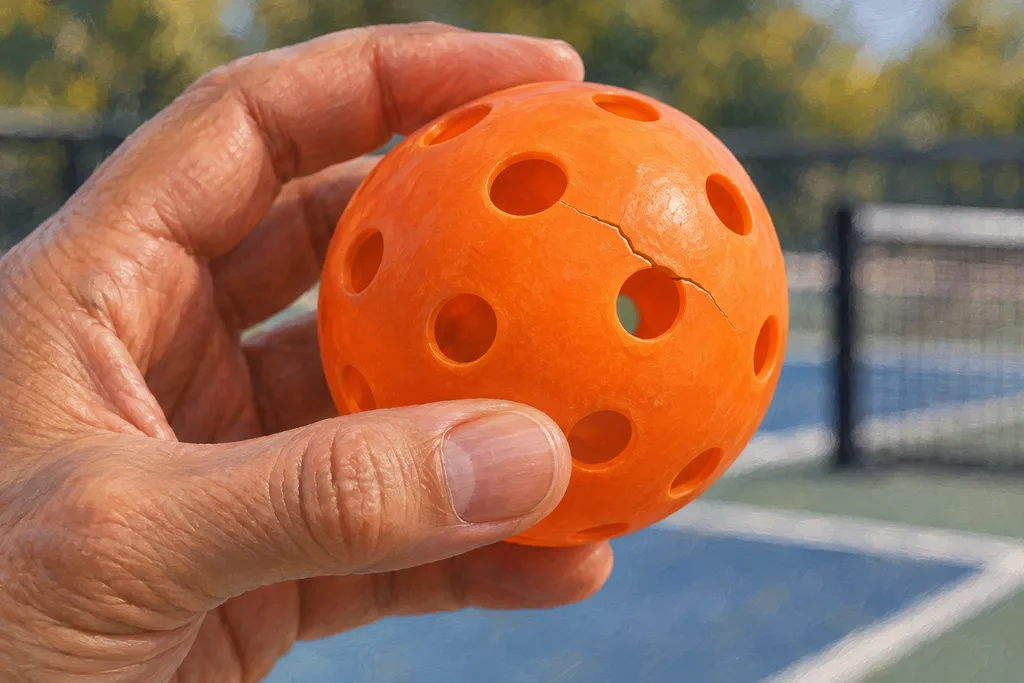
Under the title "Cracked Pickleballs: How to Spot One and Why to Pull It From Play," this page goes point by point, with no loose vocabulary. You'll know how to inspect a ball and decide to pull it from play. As you read, you'll come across situations of use, what to base your decision on, and the sequence to follow. It's especially suited to pickleball players, recreational or competitive, and to club or association managers who want to keep their balls in good shape and know when to replace them.
Situations of Use
Start at the source: three factors speed up a ball's wear: the weather (extreme cold and heat that warp or crack it), how often it's used and how hard it's hit.
The basis comes down to this: pickleballs turn brittle and prone to damage when the temperature drops below 0 °C (32 °F), and they can soften and warp in high heat.
What to Base Your Decision On
The factors to weigh are in the list below.
- Balls are considered worn when they lose more than 10% of their original stiffness: competitive players then notice a drop in performance, since the ball compresses more easily by hand.
- In hot weather, a Franklin X-40's stiffness falls to about half its value at room temperature: the ball deforms more and, after repeated deformation, can crack.
- The signs that justify replacing a ball are visible cracks or splits, surface wear, a reduced bounce and a changed sound on impact.
- Pickleball Science sorts a ball's durability into three categories based on the number of games before it cracks or loses a noticeable amount of stiffness: low under 10 games, medium from 10 to 20 games, high beyond 20 games.
- A new ball feels livelier because its stiffness deforms the paddle face more, and the face acts like a trampoline; a softer ball produces less of that effect and leaves the paddle more slowly.
The Sequence to Follow
Follow the sequence below, and don't swap the steps around.
- To extend the life of your balls, store them at a stable, moderate temperature, out of direct sun, in breathable rather than airtight containers to avoid moisture.
- A ball that has lost its stiffness can be moved down to recreational play or practice: in the test, the Franklin X-40 still lasted about a dozen recreational games before cracking.
Where Do Cracks Appear?
A recorded value: in a comparison test of two new outdoor balls, the Onix DuraFast 40 and the Franklin X-40 each weighed 0.95 ounce.
Here's an application: in this durability ranking, the Pro Penn 40 went past 30 games with about 5% stiffness loss, while the Franklin X-40 had lost 10% of its stiffness in 7 games.
A recorded value: after 30 test games, the DuraFast 40 still weighed 0.95 ounce while the Franklin X-40 had dropped to 0.92 ounce.
Does the Sound on Impact Change?
A case in point: according to the same guide, an outdoor ball lasts from a month to a few months, so it needs replacing more often than an indoor ball.
A measured result: in this test, both outdoor balls cracked after about 30 to 32 games: about 32 for the DuraFast 40 and about 30 for the Franklin X-40.
Checking a Ball for Wear
These are the signs that justify pulling a ball from play.
- Look for visible cracks across the whole surface — A visible crack is a reason to replace the ball.
- Compare the bounce with a new ball's — A changed bounce signals a tired ball.
- Listen to the sound on impact — A different sound points to a change in the ball.
- Check for warping after a spell of heat — Heat can soften and warp the ball.
Before You Close This Page
The page has walked you through situations of use, what to base your decision on, and the sequence to follow. Go back over the passages that match your situation before you settle on a routine.
Go further
- When to Replace a Pickleball: Signs of Wear — Know when to change a ball. Here you'll find, in order: the fundamentals of the topic, the published pieces, and where to start, step by step.
- Club Ball Budget: Estimating the Annual Replacement — You'll estimate the budget for replacing your association's balls. Topics covered: a few points of context and the detailed procedure.
- Soft Ball or Unstable Flight: Diagnosing a Worn-Out Ball — You'll learn to tell a worn-out ball from the effect of wind or temperature. This page covers what's under the hood and the sequence to follow.
- When to Replace Your Balls: Lifespan Indoors and Outdoors — You'll get lifespan benchmarks and learn how to adjust them to the way you play. The discussion is built around what the measurements show.
Sources
- Pickleball Union : combien de temps durent les balles de pickleball — Information page on ball lifespan and replacement criteria. Source reviewed online on 2026-10-13.
- Pickleball Union : entretenir et ranger ses balles de pickleball — Cleaning tips using warm water and mild soap, and storage at a stable temperature; editorial site with affiliate links. Source reviewed online on 2026-10-13.
- Pickleball Science : durabilité et usure de balles de pickleball — Durability test method, 10% stiffness-loss threshold, durability categories, results by model. Source reviewed online on 2026-10-13.
- Pickleball Science : comment la température affecte une balle de pickleball — Stiffness measurements of eight balls at three temperatures (about -1 °C, 23 °C and 49 °C). Source reviewed online on 2026-10-13.
- Pickleball Science : pourquoi les balles neuves ont plus de « pop » — Stiffness of new and used balls, link to paddle exit speed, bounce standard. Source reviewed online on 2026-10-13.
- Pickleball Science : usure et perte de raideur d'une balle Franklin X-40 — Stiffness measured on a new ball, then after one and two hours of play. Source reviewed online on 2026-10-13.
- Pickleball Science : comparaison Onix DuraFast 40 et Franklin X-40 — Measurements of stiffness and weight, plus microscope inspection: change in stiffness and cracks around the holes after about 32 games. Source reviewed online on 2026-10-13.
Sources and Verification.
- This article cites 7 sources: 5 scientific publications.
- Facts last checked against their sources: October 13, 2026.
- How sources are chosen and verified: Editorial Principles.