Beginner: Understanding Perforations and Ball Type
Published Oct 24, 2026 Updated Oct 24, 2026 4-minute read
Text by the Rebond Durable editorial team.
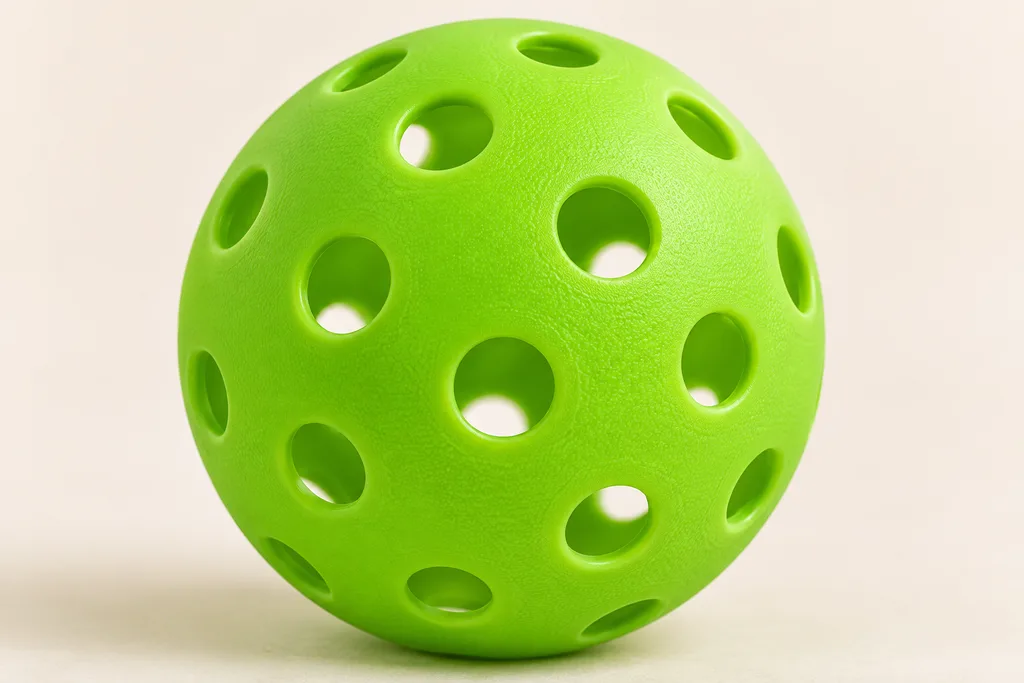
This page, "Débutant : comprendre les perforations et le type de balle," reads like an officiating report: plain, orderly, precise. You'll learn to read a ball: holes, material, intended use. Each part has its job in this order: how it works in detail, and the basics to set down first. It'll suit pickleball players, recreational or competitive, and club or association managers who want to keep their balls in good shape and know when to replace them.
How It Works in Detail
Here's where the reasoning starts: when it's hot, a ball becomes very soft and deforms a lot. The polymer then dissipates energy through internal friction, and the ball feels slow or mushy. Large, repeated deformations also raise the risk of cracks. Reread that before moving on to the next points.
A key principle: the rulebook requires the ball to be a single uniform color, apart from identification markings, and to carry the manufacturer's identification. Tie each point that follows back to that statement.
Here's where the reasoning starts: a ball's lifespan depends on its type. An indoor ball lasts from a few months to a year, an outdoor ball from one month to a few months.
Let's set out the principle: a slight seam ridge is allowed on the ball as long as it doesn't noticeably affect its flight. Make a note of it before you go on.
The Basics to Set Down First
Carry out the following steps one after the other.
- Pickleball Science recommends keeping track of how your balls are used, spotting soft areas, and replacing balls early, especially after more than 12 games.
- Cleaning is a chance to inspect each ball — cracks, splits or surface wear are signs of deterioration, as is a change in bounce quality or in the sound on impact.
- To clean a pickleball, the six-step method goes like this: prepare lukewarm soapy water, let the balls soak briefly, rub gently with a soft cloth, rinse thoroughly, pat dry with a towel, then inspect the ball.
- Breathable storage, such as a mesh bag, is better than an airtight container for keeping your balls.
Why Is a Ball Perforated?
An everyday scene: pickleball is played with a solid paddle and a perforated ball, on a court measuring 9 m by 18 m according to the regional press.
An everyday scene: in the Pickleball Science comparison, the DuraFast 40 lost 8 % of its stiffness over 32 games, while the Franklin X-40 lost 10 % every 4 games. Both cracked at around 30 games.
A typical situation: according to Pickleball Union, an outdoor ball shows signs of wear after about 9 to 10 games, while an indoor ball generally lasts longer because it faces fewer environmental stresses.
How Many Holes Does the Rulebook Allow?
To make it concrete, to test durability, Pickleball Science played with USAPA-approved balls on outdoor concrete courts in Florida, with intermediate-level (3.5) players. Stiffness was measured under loads of 5 to 30 lb.
A good habit: after cleaning, you should inspect the ball. It's the last step of the recommended method, and it lets you catch cracks or damage before the ball goes back into play.
A recorded value: to study the effect of temperature, Pickleball Science measured the stiffness of eight popular balls at three temperatures: about -1 °C (30 °F), 23 °C (73 °F) and 49 °C (120 °F).
The Useful Summary
The list below sums up what's worth remembering.
- Cleaning is a chance to inspect each ball.
- A ball's lifespan depends on its type.
- After cleaning, you should inspect the ball.
Closing the File
The steps of this write-up were: how it works in detail, and the basics to set down first. Check these lines against your own play before making any decision.
Go further
- Approved Tournament Balls: Where to Find the Official Lists — You'll learn how to check whether a ball is allowed in a tournament. The outline covers the logic at work and the steps to follow, one by one.
- Club Cleaning: Organizing the Washing of a Ball Stock — You'll be able to set up a simple washing routine for a club's ball stock. The discussion is built around a close look at the situation.
- Gear Bag Storage: Mistakes That Damage Your Pickleballs — You'll spot the storage habits that warp pickleballs. Sections covered: the reasons to understand and the common missteps.
- Storing Your Pickleballs: Heat, Cold, and Best Practices — Store your balls at the right temperature. This page is built around the rules that govern the section and the pieces to read next.
Sources
- Pickleball Science : comment la température affecte une balle de pickleball — Stiffness measurements of eight balls at three temperatures (about -1 °C, 23 °C and 49 °C). Last reviewed: 2026-10-13.
- Règlement USA Pickleball 2025, section 2 : terrain et équipement — Summary of the rulebook: 26 to 40 holes, smooth surface, uniform color, ball on the approved list at a sanctioned tournament. Last reviewed: 2026-10-13.
- Pickleball Union : entretenir et ranger ses balles de pickleball — Tips on cleaning with lukewarm water and mild soap, and on storing at a stable temperature; editorial site with affiliate links. Last reviewed: 2026-10-13.
- Pickleball Science : usure et perte de raideur d'une balle Franklin X-40 — Stiffness measurement of a new ball, then after one and two hours of play. Last reviewed: 2026-10-13.
- Nîmes : le premier club du Sud entièrement dédié au pickleball ouvrira fin mars — Reports the official integration of pickleball into the French Tennis Federation as of January 1, 2026. Last reviewed: 2026-10-13.
- Pickleball Science : comparaison Onix DuraFast 40 et Franklin X-40 — Stiffness and weight measurements and microscope inspection: change in stiffness and cracks around the holes after about 32 games. Last reviewed: 2026-10-13.
- Pickleball Union : combien de temps durent les balles de pickleball — Information page on ball lifespan and replacement criteria. Last reviewed: 2026-10-13.
- Pickleball Science : durabilité et usure de balles de pickleball — Durability test method, 10 % stiffness-loss threshold, durability categories, results by model. Last reviewed: 2026-10-13.
Sources and Verification.
- This article cites 8 sources: 4 scientific publications and 1 press article.
- Last fact-check against the sources: October 13, 2026.
- How sources are chosen and verified: Principes éditoriaux.