Storing Your Pickleballs: Heat, Cold, and Best Practices
Published Oct 24, 2026 Updated Oct 24, 2026 6-minute read
Text by the Rebond Durable editorial team.
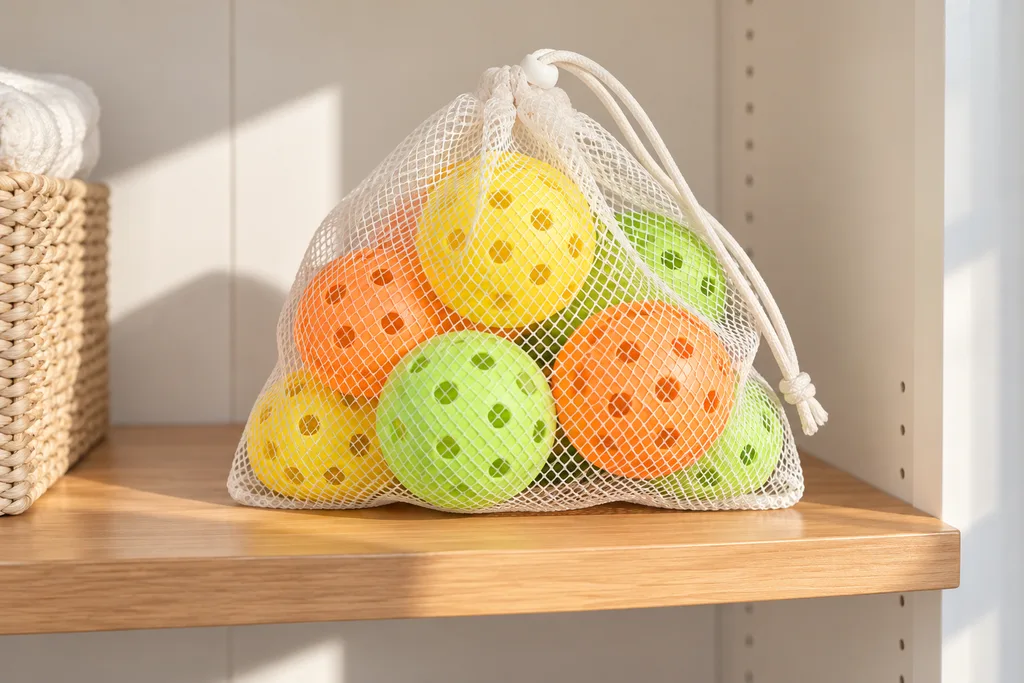
Temperature affects how flexible the plastic is. This section covers storage solutions for your bag, your car, and the club. You're on the home page of “Storing and Stowing,” which sets up the readings on offer.
The Rules That Govern the Section
What governs everything: the 2025 USA Pickleball rulebook says a ball must have at least 26 and at most 40 circular holes, whose spacing and pattern must meet conforming flight characteristics. Note that before you go on.
Regulatory framework: Pickleball Canada states that the balls approved for its tournaments are those tested and approved by USA Pickleball, whose list is published on that federation's website.
Point of doctrine: in a tournament sanctioned by USA Pickleball, the tournament director chooses the ball, which must appear on the official list of approved balls published on the USA Pickleball website.
What governs everything: at very high temperatures, a ball doesn't necessarily break, but it can soften and deform (warp).
At the root of the reasoning, the rules require the ball to be a single uniform color, apart from identification markings, and to carry the manufacturer's identification. Keep that statement as your reference for what follows.
Pieces to Browse
Keep reading with one of the texts below.
- Cleaning a Pickleball: The Gentle Method, Step by Step — you'll know how to clean your balls with soapy water without damaging the plastic.
- Drying Pickleballs: Why to Avoid Direct Sun and Radiators — you'll avoid drying mistakes that warp or weaken a ball.
- Club Cleaning: Organizing the Washing of a Ball Stock — you'll be able to set up a simple washing routine for a club's supply.
- Where to Store Your Pickleballs: Cool, Dry, and Out of the Sun — you'll know how to choose the right spot and the right container for storing your balls.
- Heat, Freezing, and Warping: What Temperature Does to a Ball — you'll understand how heat and cold alter a ball and how to protect it.
- Packing Your Gear Bag: Mistakes That Damage Your Balls — you'll spot the storage habits that deform balls.
- Indoor or Outdoor Ball: The Differences to Know — you'll know how to pick the ball suited to your surface and your venue.
- Caring for an Outdoor Ball: Dust, Grit, and Sun — you'll adapt cleaning and storage to the demands of outdoor play.
- Beginner: Understanding Perforations and Ball Type — you'll know how to read a ball: holes, material, intended use.
- Regulatory Specifications for the Pickleball: What the Rules Say — you'll know what the rulebook requires for ball construction.
- Approved Balls in Competition: Finding the Official Lists — you'll know how to check whether a ball is allowed in a tournament.
- IFP, USA Pickleball, Pickleball Canada: Who Sets the Ball Standards? — you'll place the organizations and their reference documents.
A Recommended Starting Point
Follow the procedure below, step by step.
- Before storing dirty balls, you can clean them in six steps: prepare warm soapy water, soak them in it for a few minutes, rub them gently with a damp cloth, rinse them in clear water, dry them completely with a towel, then inspect them.
- Rinsing the balls thoroughly and then blotting them after washing keeps you from storing them damp, since storage should be done on perfectly dry balls.
- Avoid exposing balls directly to the sun while they're stored, since it degrades the plastic.
- After cleaning, inspect the ball. It's the last step of the recommended method, and it lets you catch cracks or damage before putting the ball back in play.
- Breathable storage, such as a mesh bag, is better than an airtight container for keeping your balls.
Weighing the Options
Go over the criteria below before you decide.
- According to Pickleball Union, an indoor ball resists wind poorly, whereas an outdoor ball is heavier to limit wind disturbance.
- According to Pickleball Union, a ball should be replaced if it's cracked, warped, or bounces crooked, or if its measurements fall outside USA Pickleball specifications (diameter of 2.87 to 2.97 in, weight of 0.78 to 0.935 oz).
- In this test, a ball was at the end of its life if it cracked, lost more than 10% of its stiffness, or reached 30 games. It was rated low durability under 10 games, medium between 10 and 20, and high beyond 20.
- According to Pickleball Science, to play in cold weather you should choose a ball whose stiffness at low temperature is below 180 lb/in. For heat, you need a high-temperature stiffness above 80 lb/in.
A Few Anchor Points
To make it concrete, pickleball is played with a solid paddle and a perforated ball, on a court 9 m by 18 m, according to the regional press.
Measured value: in a test on a Franklin X-40 ball, stiffness went from 93.5 lb/in when new to 84.0 lb/in after one hour of play, then to 75.2 lb/in after two hours, a loss of about 10% per hour.
Observed development: since January 1, 2026, pickleball has been officially part of the Fédération française de tennis, according to the regional press.
Pitfalls to Avoid
The common mistakes are listed below.
- An indoor ball should only be used outside in calm weather, without wind. Its soft material wears down easily on the rough surfaces of outdoor courts.
- It's best to avoid direct sun when cleaning and drying balls, since it can degrade the plastic.
- Rinse the soap off thoroughly with clear water after washing, or the balls stay slippery.
- A worn ball develops soft spots where finger pressure leaves a dent, and it eventually keeps a permanent deformation. Check it before putting it back in the playing stock.
Go further
- Where to Store Your Pickleballs: Cool, Dry, and Out of the Sun — You'll learn how to pick the right spot and the right container for storing your pickleballs. The page covers how it works, then the full procedure.
- Caring for an Outdoor Ball: Dust, Grit, and Sun — You'll adapt cleaning and storage to the demands of outdoor play. Sections covered: under the hood and how the process unfolds.
- Heat, Frost, and Warping: What Temperature Does to a Ball — You'll see how heat and cold alter a ball and how to protect it. Parts covered: the observed facts and the mechanism behind the phenomenon.
- Pickleball Ball Specifications: What the Rules Say — You'll learn what the rules require for ball construction. This page is laid out in three parts, starting with how it works in detail.
Sources
- Règlement USA Pickleball 2025, section 2 : terrain et équipement — Rulebook excerpt: 26 to 40 holes, smooth surface, uniform color, and a ball that appears on the approved list in a sanctioned tournament. Accessed on 2026-10-13.
- Pickleball Canada : balles et raquettes approuvées — States that approved balls are based on the balls tested and approved by USA Pickleball. Accessed on 2026-10-13.
- Pickleball Union : entretenir et ranger ses balles de pickleball — Tips on cleaning with warm water and mild soap, and on storing at a stable temperature; an editorial site with affiliate links. Accessed on 2026-10-13.
- Pickleball Union : différence entre balles d'intérieur et d'extérieur — Characteristics, using an indoor ball outside, and durability. Accessed on 2026-10-15.
- Pickleball Science : usure et perte de raideur d'une balle Franklin X-40 — Stiffness measurement of a new ball, then after one and two hours of play. Accessed on 2026-10-13.
- Pickleball Union : combien de temps durent les balles de pickleball — An informational page on ball lifespan and replacement criteria. Accessed on 2026-10-13.
- Pickleball Science : durabilité et usure de balles de pickleball — Durability test method, the 10% stiffness-loss threshold, durability categories, and results by model. Accessed on 2026-10-13.
- Pickleball Science : comment la température affecte une balle de pickleball — Stiffness measurements of eight balls at three temperatures (about -1 °C, 23 °C and 49 °C). Accessed on 2026-10-13.
- Nîmes : le premier club du Sud entièrement dédié au pickleball ouvrira fin mars — Reports pickleball's official integration into the Fédération française de tennis since January 1, 2026. Accessed on 2026-10-13.
Sources and Verification.
- This article cites 9 sources: 1 official or institutional source, 3 scientific publications, and 1 press article.
- Facts last checked against their sources: October 13, 2026.
- How sources are chosen and verified: Editorial Principles.