Where to Store Your Pickleballs: Cool, Dry, and Out of the Sun
Published Oct 24, 2026 Updated Oct 24, 2026 4-minute read
Text by the Rebond Durable editorial team.
You're reading “Where to Store Your Pickleballs: Cool, Dry, and Out of the Sun,” an account that sticks close to established facts. You'll learn how to pick the right spot and the right container for storing your pickleballs. It's organized around these sections: how it works, the detailed procedure, and what to base your decision on. This guide is meant for pickleball players, recreational or competitive, and for club or association managers who want to keep their balls in good shape and know when to replace them.
How It Works, Plain and Simple
On the rules side, Pickleball Canada states that the balls approved for its tournaments are those tested and approved by USA Pickleball, whose list is published on that organization's website.
Here's what governs everything else: below freezing (0 °C / 32 °F), pickleballs turn brittle, which makes them more prone to cracks.
The basic rule: store balls somewhere with a stable, moderate temperature, because extreme temperatures, hot or cold, can alter their shape and durability. Tie every point that follows back to that statement.
A rule worth noting: Pickleball Canada specifies that its list of approved balls rests on the balls tested and approved by USA Pickleball.
The Detailed Procedure
Follow the numbered list below.
- For storage, keep the balls completely dry and, in a humid climate, slip desiccant packets into the container.
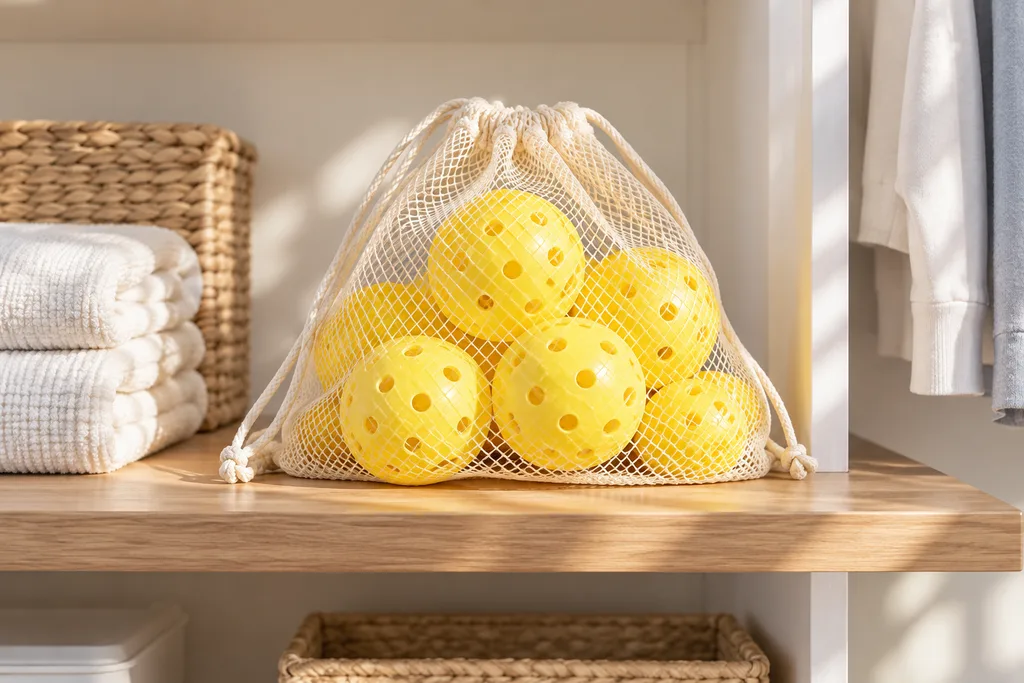
- Breathable storage, such as a mesh bag, is better than an airtight container for keeping your balls.
- After washing, let the balls air-dry in a well-ventilated spot out of direct sunlight, because moisture encourages mold and fungus during storage.
- To clean a pickleball, the six-step method is to prepare lukewarm soapy water, let the balls soak briefly, rub gently with a soft cloth, rinse generously, blot dry with a towel, then inspect the ball.
- Don't overfill the ball storage container: the Pickleball Union guide advises against it, in addition to recommending ventilated containers.
What to Base Your Decision On
Base your decision on the following points.
- When it's hot, a ball gets very soft and deforms a lot. The polymer then dissipates energy through internal friction, and the ball feels slow or mushy. Repeated large deformations also raise the risk of cracks.
- At very high temperatures, a ball doesn't necessarily break, but it can soften and deform (warp).
- A ball's lifespan also depends on how hard you play: a casual player who plays once a week wears out balls much more slowly than an aggressive player who piles up drives and smashes, as opposed to controlled dinking.
- Proper ball care prevents unpredictable bounces, protects against warping and cracks, limits replacements and helps keep playing conditions fair.
- In a USA Pickleball-sanctioned tournament, the tournament director chooses the ball, which must appear on the official list of approved balls published on the USA Pickleball website.
What This Page Teaches
Keep the following benchmarks in mind.
- A ball's lifespan also depends on how hard you play.
- Don't overfill the ball storage container.
The Bottom Line in Detail
The stages of this account were: how it works, the detailed procedure, and what to base your decision on. Compare these benchmarks with what you've observed yourself, then judge on the evidence.
Go further
- Storing Your Pickleballs: Heat, Cold, and Best Practices — Store your balls at the right temperature. This page is built around the rules that govern the section and the pieces to read next.
- Caring for an Outdoor Ball: Dust, Grit, and Sun — You'll adapt cleaning and storage to the demands of outdoor play. Sections covered: under the hood and how the process unfolds.
- Pickleball Ball Specifications: What the Rules Say — You'll learn what the rules require for ball construction. This page is laid out in three parts, starting with how it works in detail.
- Club Cleaning: Organizing the Washing of a Ball Stock — You'll be able to set up a simple washing routine for a club's ball stock. The discussion is built around a close look at the situation.
Sources
- Pickleball Canada : balles et raquettes approuvées: States that approved balls rest on the balls tested and approved by USA Pickleball. Source consulted on 2026-10-13.
- Pickleball Union : entretenir et ranger ses balles de pickleball: Advice on cleaning with lukewarm water and mild soap, and on storing at a stable temperature; an editorial site with affiliate links. Source consulted on 2026-10-13.
- Pickleball Science : comment la température affecte une balle de pickleball: Stiffness measurements of eight balls at three temperatures (about -1 °C, 23 °C and 49 °C). Source consulted on 2026-10-13.
- Pickleball Union : combien de temps durent les balles de pickleball: An information page on ball lifespan and replacement criteria. Source consulted on 2026-10-13.
- Règlement USA Pickleball 2025, section 2 : terrain et équipement: Restatement of the rulebook: 26 to 40 holes, smooth surface, uniform color, ball listed as approved in sanctioned tournaments. Source consulted on 2026-10-13.
Sources and Verification.
- This article cites 5 sources: 1 official or institutional source and 1 published study.
- Facts last checked against their sources: October 13, 2026.
- How sources are chosen and verified: Editorial Principles.