Club Cleaning: Organizing the Washing of a Ball Stock
Published Oct 24, 2026 Updated Oct 24, 2026 3-minute read
Text by the Rebond Durable editorial team.
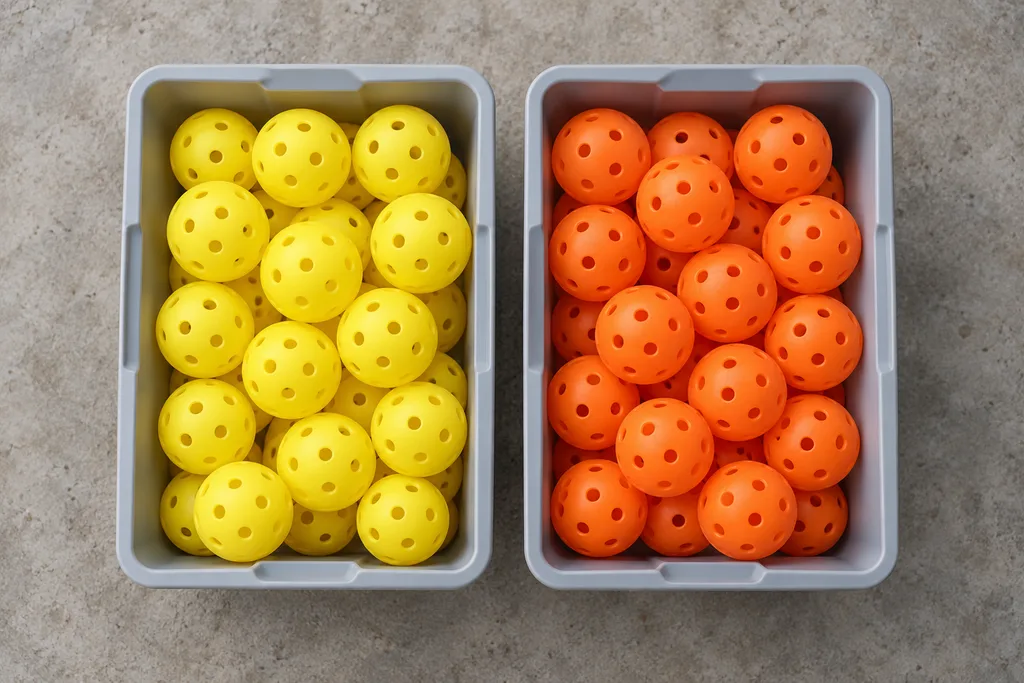
You're reading "Club Cleaning: Organizing the Washing of a Ball Stock," a piece that stays as close as it can to established facts. You'll be able to set up a simple washing routine for a club's ball stock. Each section has its own job, in this order: a close look at the situation, the sequence of steps, and the choices you have. This guide is meant for pickleball players, recreational or competitive, and for club or association managers who want to keep their balls in good shape and know when to replace them.
A Close Look at the Situation
One principle to keep in mind: outdoor courts made of asphalt or concrete wear balls down faster than smooth gym floors, because indoor surfaces absorb impact better. Rain, wind, and snow add surface wear.
At the root of the reasoning, a ball's lifespan depends on its type. An indoor ball lasts from a few months to a year, and an outdoor ball from a month to a few months.
The foundation is this: newer, stiffer balls create a stronger "trampoline" effect on the paddle, which adds energy to the bounce and gives more speed than softer balls do. Advanced players benefit the most from new, stiff balls. Lean on that point as you read what follows.
The Sequence of Steps
Follow the procedure below, step by step.
- Rinse the balls thoroughly and blot them dry after washing so you don't store them damp. They should go into storage completely dry.
- Don't overfill the storage container. The Pickleball Union guide advises against it, and it also recommends ventilated containers.
- For storage, keep the balls completely dry and, in a humid climate, slip desiccant packets into the container.
- Avoid exposing the balls to direct sunlight while they're in storage, because it breaks down the plastic.
- To clean a pickleball, the six-step method is: prepare lukewarm soapy water, let the balls soak briefly, rub gently with a soft cloth, rinse thoroughly, blot dry with a towel, then inspect the ball.
The Choices You Have
Weigh each option against the criteria below.
- The rules require the ball to be a single uniform color, apart from identification markings, and to carry the manufacturer's identification.
- A ball's lifespan also depends on how intensely you play. A casual player who plays once a week wears out balls far more slowly than an aggressive player who piles on drives and smashes, in contrast to controlled dinking.
- A slight seam ridge is allowed on the ball if it doesn't noticeably affect its flight.
- The 2025 USA Pickleball rules call for a ball to have at least 26 and at most 40 circular holes, and their spacing and design must give compliant flight characteristics.
Common Missteps
The list below covers the most frequent mistakes.
- It's best to avoid direct sunlight when you clean and dry the balls, because it can break down the plastic.
- Rinse the soap off well with clean water after washing, or the balls will stay slippery.
What This Page Teaches
Keep these points in mind.
- Don't overfill the storage container.
- A ball's lifespan depends on its type.
- A ball's lifespan also depends on how intensely you play.
Before You Close This Page
As a reminder, the outline was: a close look at the situation, the sequence of steps, the choices you have, and common missteps. Keep this text handy so you can come back to it whenever a question comes up.
Go further
- Caring for an Outdoor Ball: Dust, Grit, and Sun — You'll adapt cleaning and storage to the demands of outdoor play. Sections covered: under the hood and how the process unfolds.
- Storing Your Pickleballs: Heat, Cold, and Best Practices — Store your balls at the right temperature. This page is built around the rules that govern the section and the pieces to read next.
- Drying Pickleballs: Why to Avoid Direct Sun and Radiators — You'll avoid the drying mistakes that warp or weaken a ball. Here's what you'll find, in order: the groundwork to take in first.
- Beginner: Understanding Perforations and Ball Type — You'll learn to read a ball: holes, material, intended use. The outline covers how it works in detail and the basics to set down first.
Sources
- Pickleball Union : combien de temps durent les balles de pickleball — Information page on ball lifespan and replacement criteria. Source read on 2026-10-13.
- Pickleball Union : entretenir et ranger ses balles de pickleball — Tips for cleaning with lukewarm water and mild soap and for storing at a stable temperature; editorial site with affiliate links. Source read on 2026-10-13.
- Pickleball Science : pourquoi les balles neuves ont plus de « pop » — Stiffness of new and used balls, link to paddle exit speed, bounce standard. Source read on 2026-10-13.
- Règlement USA Pickleball 2025, section 2 : terrain et équipement — Summary of the rules: 26 to 40 holes, smooth surface, uniform color, ball on the approved list in a sanctioned tournament. Source read on 2026-10-13.
Sources and Verification.
- This article cites 4 sources, 1 of them a published study.
- Facts last checked against their sources: October 13, 2026.
- How sources are chosen and verified: Principes éditoriaux.