Drying Pickleballs: Why to Avoid Direct Sun and Radiators
Published Oct 24, 2026 Updated Oct 24, 2026 3-minute read
Text by the Rebond Durable editorial team.
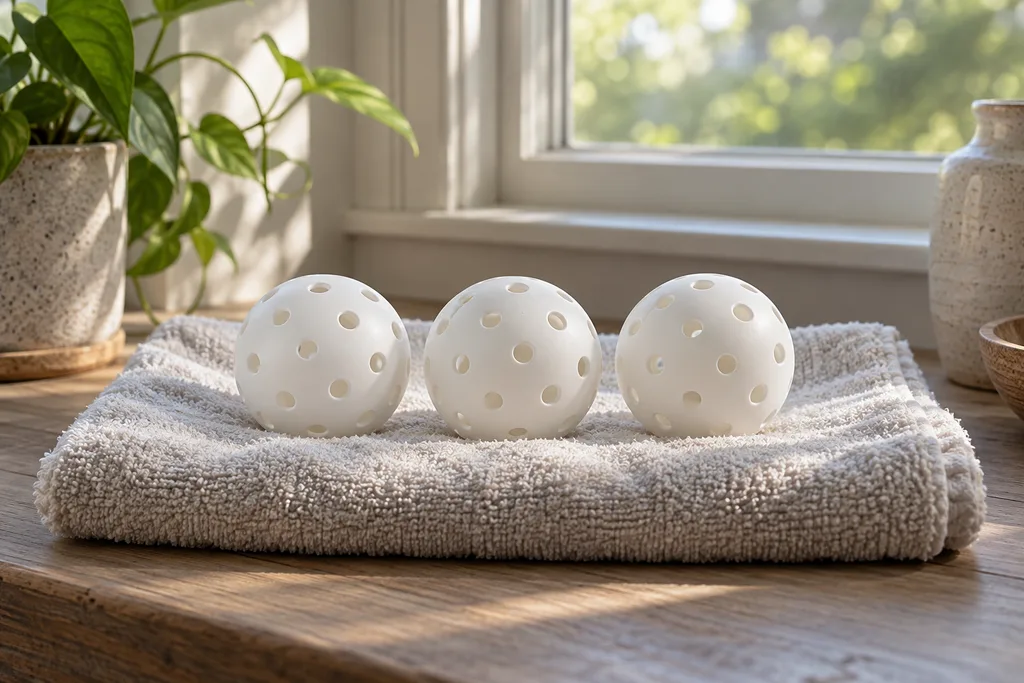
"Séchage des balles de pickleball : pourquoi éviter le soleil direct et le radiateur": here's the file, worked through in order and in detail. You'll avoid the drying mistakes that warp or weaken a ball. The page is laid out like this: the groundwork to take in first, the risks of getting it wrong, and the way forward from here. It's meant for pickleball players, recreational or competitive, and for club or association managers who want to keep their balls in good shape and know when to replace them.
The Groundwork to Take In
A basic rule: with a worn ball, you have to hit harder to get the same speed, which tires the player more. The extra contact and the rougher surface, on the other hand, can produce more spin.
Let's set out the principle: store your balls somewhere with a stable, moderate temperature, because extreme temperatures, hot or cold, can alter their shape and durability.
Let's set out the principle: according to Pickleball Science, a ball's stiffness isn't the main factor in bounce height. A new ball and a worn one can both fall within the standard's 30 to 34 inch bounce range. Make a note of it before you go on.
For a concrete reference, see the Rally online store, with "Balles de pickleball extérieur — Packs de 3 ou 6," to put things in context.
The Risks of Getting It Wrong
The list below covers the most frequent mistakes.
- Rinse the soap off with clean water after washing, or the balls stay slippery.
- An indoor ball should only be used outside in calm weather, with no wind. Its soft material wears out easily on the rough surfaces of outdoor courts.
- It's best to avoid direct sunlight when you clean and dry your balls, because it can degrade the plastic.
- A worn ball develops soft spots where finger pressure leaves a dent, and it eventually keeps a permanent deformation. So check it before you put it back in your playing stock.
The Way Forward From Here
Carry out the following steps one after the other.
- After cleaning, inspect the ball. It's the last step of the recommended method, and it lets you spot cracks or damage before the ball goes back into play.
- Before storing dirty balls, you can clean them in six steps: prepare lukewarm soapy water, soak the balls in it for a few minutes, rub them gently with a damp cloth, rinse them with clean water, dry them completely with a towel, then inspect them.
- To clean a pickleball, the six-step method calls for preparing lukewarm soapy water, letting the balls soak briefly, rubbing gently with a soft cloth, rinsing thoroughly, blotting with a towel, then inspecting the ball.
- Don't overfill the container you store your balls in. The Pickleball Union guide advises against it, and it also recommends ventilated containers.
- Pickleball Science recommends keeping an eye on how your balls are used, spotting soft areas, and replacing them early, especially after more than 12 games.
Can You Dry a Ball in the Sun?
To do it properly, when storing balls, keep them completely dry and, in a humid climate, slip desiccant packets into the container.
Let's set out the principle: proper ball care prevents unpredictable bounces, protects against warping and cracks, cuts down on replacements, and helps keep playing conditions fair.
The Useful Summary
The list below boils down what to keep in mind.
- After cleaning, inspect the ball.
- Don't overfill the container you store your balls in.
Closing the File
The steps of this discussion were: the groundwork to take in first, the risks of getting it wrong, and the way forward from here. Come back to the relevant sections whenever a doubt comes up.
Go further
- Storing Your Pickleballs: Heat, Cold, and Best Practices — Store your balls at the right temperature. This page is built around the rules that govern the section and the pieces to read next.
- Heat, Frost, and Warping: What Temperature Does to a Ball — You'll see how heat and cold alter a ball and how to protect it. Parts covered: the observed facts and the mechanism behind the phenomenon.
- Club Cleaning: Organizing the Washing of a Ball Stock — You'll be able to set up a simple washing routine for a club's ball stock. The discussion is built around a close look at the situation.
- Caring for an Outdoor Ball: Dust, Grit, and Sun — You'll adapt cleaning and storage to the demands of outdoor play. Sections covered: under the hood and how the process unfolds.
Sources
- Pickleball Science : usure et perte de raideur d'une balle Franklin X-40 — Stiffness measured on a new ball, then after one and two hours of play. Source reviewed online on 2026-10-13.
- Pickleball Union : entretenir et ranger ses balles de pickleball — Tips on cleaning with lukewarm water and mild soap, and on storing at a stable temperature; editorial site with affiliate links. Source reviewed online on 2026-10-13.
- Pickleball Science : pourquoi les balles neuves ont plus de « pop » — Stiffness of new and used balls, link to paddle exit speed, bounce standard. Source reviewed online on 2026-10-13.
- Pickleball Union : différence entre balles d'intérieur et d'extérieur — Characteristics, using an indoor ball outside, durability. Source reviewed online on 2026-10-15.
Sources and Verification.
- This article cites 4 sources, 2 of them scientific publications.
- Last fact-check against the sources: October 13, 2026.
- How sources are chosen and verified: Principes éditoriaux.