Caring for an Outdoor Ball: Dust, Grit, and Sun
Published Oct 24, 2026 Updated Oct 24, 2026 4-minute read
Text by the Rebond Durable editorial team.
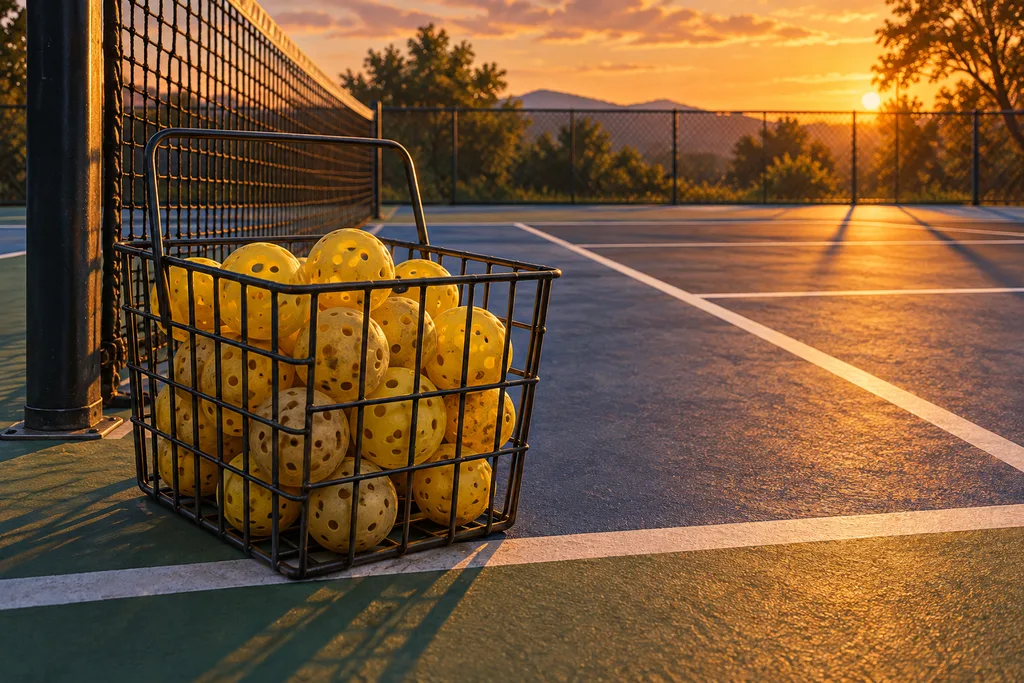
This article, "Caring for an Outdoor Ball: Dust, Grit, and Sun," goes over the subject with the rigor of an official match report. You'll adapt cleaning and storage to the demands of outdoor play. As you read, you'll come across three parts: under the hood, how the process unfolds, and what to base your decision on. It's especially useful for pickleball players, recreational or competitive, and for club or association managers who want to keep their balls in good shape and know when to replace them.
Under the Hood
As far as the rules go, Pickleball Canada states that its list of approved balls is based on the balls tested and approved by USA Pickleball.
The principle is this: newer, stiffer balls create a stronger "trampoline" effect off the paddle, which adds energy to the rebound and gives more speed than softer balls do. Advanced players benefit the most from new, stiff balls. Read it again before moving on to the next points.
As far as the rules go, Pickleball Canada says that the balls approved for its tournaments are those tested and approved by USA Pickleball, whose list is published on that organization's website.
The principle is this: below freezing (0 °C / 32 °F), pickleballs turn brittle, which makes them more prone to cracking. Keep this benchmark in mind as you read on.
Consider this case: Rally's range lists, among others, "Balles de pickleball extérieur — Packs de 3 ou 6," where applicable.
How the Process Unfolds
Here's the sequence to follow.
- Pickleball Science recommends keeping an eye on how much your balls get used, spotting soft areas, and replacing them early, especially after more than 12 games.
- Don't leave balls in direct sunlight while they're stored, because it breaks down the plastic.
- For storage, keep the balls completely dry and, in humid climates, slip desiccant packets into the container.
- Don't overload the ball storage container. The Pickleball Union guide advises against it and also recommends ventilated containers.
- Before putting away dirty balls, you can clean them in six steps: prepare warm soapy water, soak the balls in it for a few minutes, rub them gently with a damp cloth, rinse them with clean water, dry them completely with a towel, and then inspect them.
What to Base Your Decision On
Here are the criteria to look at before you decide.
- The 2025 USA Pickleball rulebook provides that a ball has at least 26 and at most 40 circular holes, whose spacing and design must give conforming flight characteristics.
- Store balls in a place with a stable, moderate temperature, because extreme temperatures, hot or cold, can alter their shape and durability.
- A ball's lifespan also depends on how intensely you play. A casual player who plays once a week wears out balls much more slowly than an aggressive player who piles up drives and smashes, unlike controlled dinking.
- Proper ball care prevents unpredictable bounces, protects against warping and cracking, cuts down on replacements, and helps keep playing conditions fair.
- A worn ball makes you hit harder to get the same speed, which adds to player fatigue. The extra contact and the rough surface can, on the other hand, help produce more spin.
Key Ideas: The Essentials
Fix these benchmarks in your memory.
- Don't overload the ball storage container.
- A ball's lifespan also depends on how intensely you play.
Before You Close This Page
As a reminder, the outline was: under the hood, how the process unfolds, and what to base your decision on. Reread the passages that apply to your situation before you settle on a choice.
Go further
- Where to Store Your Pickleballs: Cool, Dry, and Out of the Sun — You'll learn how to pick the right spot and the right container for storing your pickleballs. The page covers how it works, then the full procedure.
- Storing Your Pickleballs: Heat, Cold, and Best Practices — Store your balls at the right temperature. This page is built around the rules that govern the section and the pieces to read next.
- Club Cleaning: Organizing the Washing of a Ball Stock — You'll be able to set up a simple washing routine for a club's ball stock. The discussion is built around a close look at the situation.
- Pickleball Ball Specifications: What the Rules Say — You'll learn what the rules require for ball construction. This page is laid out in three parts, starting with how it works in detail.
Sources
- Pickleball Canada : balles et raquettes approuvées — States that approved balls are based on the balls tested and approved by USA Pickleball. Checked on 2026-10-13.
- Pickleball Science : pourquoi les balles neuves ont plus de « pop » — Stiffness of new and worn balls, link to paddle exit speed, bounce standard. Checked on 2026-10-13.
- Pickleball Union : entretenir et ranger ses balles de pickleball — Tips for cleaning with warm water and mild soap and for storing at a stable temperature; editorial site with affiliate links. Checked on 2026-10-13.
- Pickleball Science : usure et perte de raideur d'une balle Franklin X-40 — Stiffness measurement of a new ball, then after one and two hours of play. Checked on 2026-10-13.
- Règlement USA Pickleball 2025, section 2 : terrain et équipement — Restatement of the rulebook: 26 to 40 holes, smooth surface, uniform color, ball on the approved list in a sanctioned tournament. Checked on 2026-10-13.
- Pickleball Union : combien de temps durent les balles de pickleball — Informational page on ball lifespan and replacement criteria. Checked on 2026-10-13.
Sources and Verification.
- This article cites 6 sources: 1 official or institutional source and 2 scientific publications.
- Last fact-check against the sources: October 13, 2026.
- How sources are chosen and verified: Principes éditoriaux.