Indoor vs. Outdoor Pickleballs: The Differences to Know
Published Oct 24, 2026 Updated Oct 24, 2026 4-minute read
Text by the Rebond Durable editorial team.
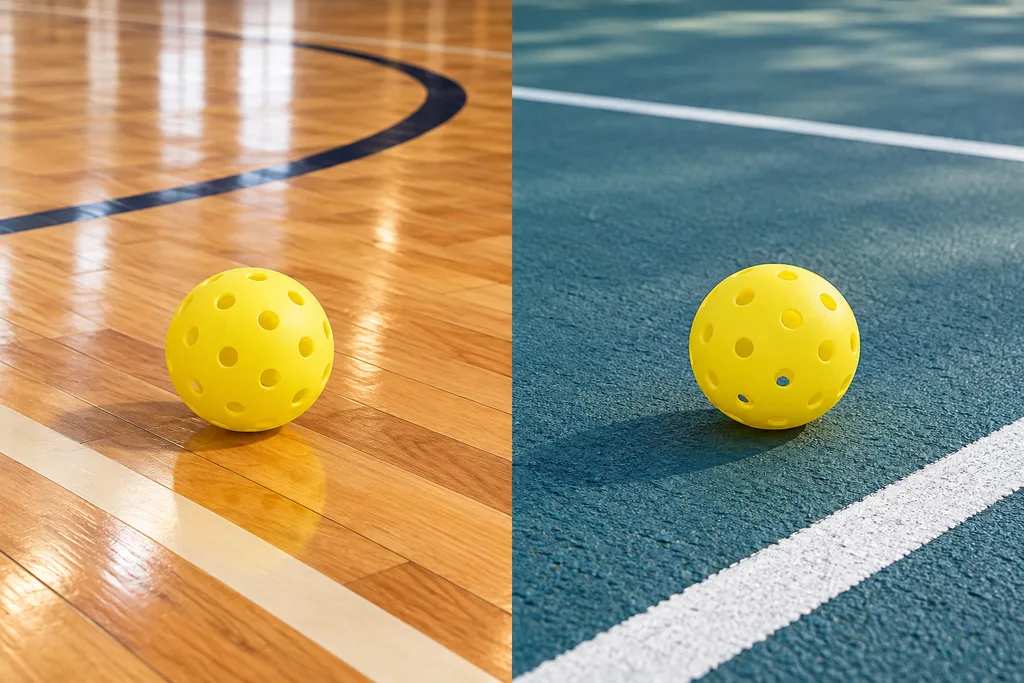
This article, "Balle d'intérieur ou d'extérieur : les différences à connaître," starts here, with carefully weighed terms and clear distinctions. You'll learn to choose the ball that suits your surface and your gym. We'll go in this order: what's being weighed against what, the criteria that decide the matter up close, and a flat layout of the elements. It's written for pickleball players, recreational or competitive, and for club or association managers who want to keep their balls in good shape and know when to replace them.
What We're Weighing Up
A matter of principle: a slight seam ridge is allowed on the ball as long as it doesn't noticeably affect its flight.
What governs everything else: a ball's lifespan depends on its type. An indoor ball lasts from a few months to a year, an outdoor ball from one month to a few months.
A point of doctrine: the rules require the ball to be a single uniform color, apart from identification markings, and to carry the manufacturer's identification.
The Criteria That Decide It Up Close
Go through the criteria below before you draw a conclusion.
- In a tournament sanctioned by USA Pickleball, the tournament director picks the ball, and it must appear on the official list of approved balls published on the USA Pickleball website.
- New balls, which are stiffer, create a stronger "trampoline" effect off the paddle. That adds energy to the rebound and gives more speed than softer balls do; advanced players benefit most from new, stiff balls.
- When it's hot, a ball becomes very soft and deforms a lot. The polymer then dissipates energy through internal friction, and the ball feels slow or mushy. Repeated large deformations also raise the risk of cracks.
- Balls used in tournaments must appear on the official list of approved balls published by USA Pickleball. They must also be a uniform color with a smooth, untextured surface, and carry the manufacturer's name or logo.
- According to Pickleball Science, a ball's stiffness isn't the main factor in bounce height: a new ball and a worn one can both fall within the standard's 30 to 34 inch bounce range.
The Elements Laid Out Flat
The following notes form the common ground for the rest of the discussion.
- According to Pickleball Science, for cold-weather play you should choose a ball whose low-temperature stiffness is under 180 lb/in. For heat, you want a high-temperature stiffness above 80 lb/in.
- After washing, let the balls air-dry in a well-ventilated spot out of direct sunlight, because moisture encourages mold and fungus during storage.
- To keep your stock organized, you can separate practice balls from those set aside for official matches, which saves you from sorting the whole collection before every session.
- Outdoor asphalt or concrete courts wear balls down more than smooth gym floors, because indoor surfaces absorb impact better. Rain, wind, and snow add surface wear.
- In this test, a ball reached the end of its life if it cracked, lost more than 10% of its stiffness, or hit 30 games. It was rated low durability under 10 games, medium between 10 and 20, and high beyond 20.
- According to Pickleball Union, an indoor ball doesn't hold up well in the wind, whereas an outdoor ball is heavier to limit wind disturbance.
Before You Close This Page
This page has taken you through what's being weighed against what, the criteria that decide the matter up close, and the elements laid out flat. Come back to the relevant sections whenever a doubt comes up.
Go further
- Storing Your Pickleballs: Heat, Cold, and Best Practices — Store your balls at the right temperature. This page is built around the rules that govern the section and the pieces to read next.
- Pickleball Ball Specifications: What the Rules Say — You'll learn what the rules require for ball construction. This page is laid out in three parts, starting with how it works in detail.
- Cleaning a Pickleball: The Gentle Method, Step by Step — You'll learn to clean your pickleballs with soapy water without damaging the plastic. The page builds on the reasoning behind the method.
- IFP, USA Pickleball, Pickleball Canada: Who Sets the Ball Standards? — You'll learn which organizations set the rules and which documents they rely on. Topics covered: what the readings show and the phenomenon explained.
Sources
- Règlement USA Pickleball 2025, section 2 : terrain et équipement — Restates the rules: 26 to 40 holes, smooth surface, uniform color, ball listed as approved in a sanctioned tournament. This reference was checked on 2026-10-13.
- Pickleball Union : entretenir et ranger ses balles de pickleball — Tips on cleaning with lukewarm water and mild soap, and on storing at a stable temperature; editorial site with affiliate links. This reference was checked on 2026-10-13.
- Pickleball Science : pourquoi les balles neuves ont plus de « pop » — Stiffness of new and used balls, link to paddle exit speed, bounce standard. This reference was checked on 2026-10-13.
- Pickleball Science : comment la température affecte une balle de pickleball — Stiffness measurements of eight balls at three temperatures (about -1 °C, 23 °C, and 49 °C). This reference was checked on 2026-10-13.
- Pickleball Union : combien de temps durent les balles de pickleball — Information page on ball lifespan and replacement criteria. This reference was checked on 2026-10-13.
- Pickleball Science : durabilité et usure de balles de pickleball — Durability test method, 10% stiffness-loss threshold, durability categories, results by model. This reference was checked on 2026-10-13.
- Pickleball Union : différence entre balles d'intérieur et d'extérieur — Characteristics, using an indoor ball outside, durability. This reference was checked on 2026-10-15.
Sources and Verification.
- This article cites 7 sources, 3 of them scientific publications.
- Last fact-check against the sources: October 13, 2026.
- How sources are chosen and verified: Principes éditoriaux.