IFP, USA Pickleball, Pickleball Canada: Who Sets the Ball Standards?
Published Oct 24, 2026 Updated Oct 24, 2026 4-minute read
Text by the Rebond Durable editorial team.
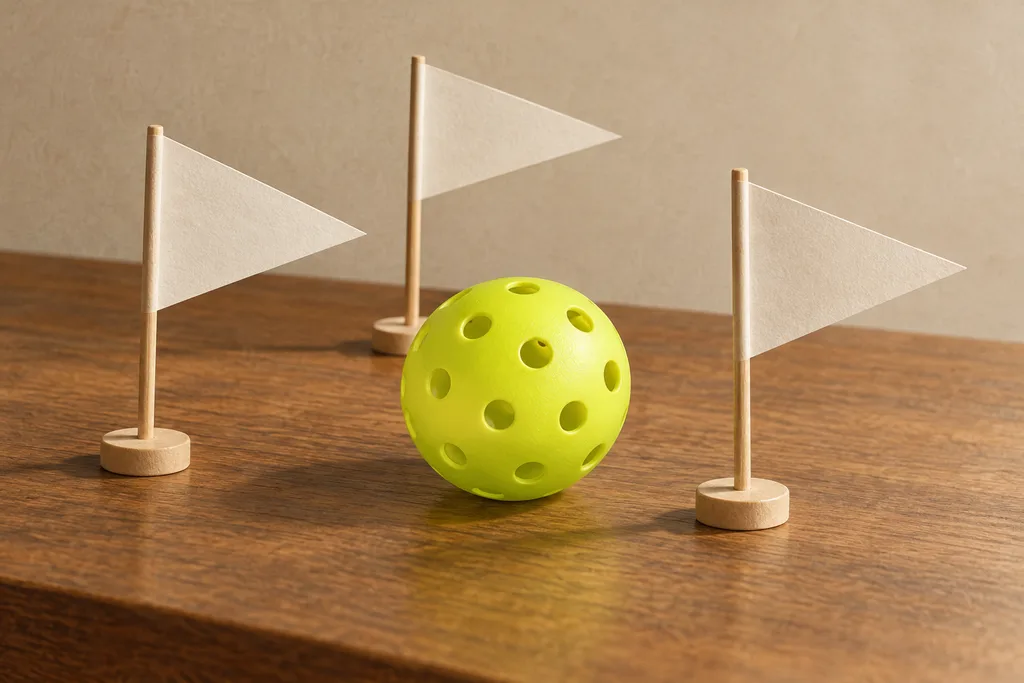
This article, titled "IFP, USA Pickleball, Pickleball Canada: Who Sets the Ball Standards?", examines the subject with the rigor of an official match report. You'll learn which organizations set the rules and which documents they rely on. It runs in this order: what the readings show, the phenomenon explained, and what to base your decision on. It will suit pickleball players, recreational or competitive, and club or association managers who want to keep their balls in good shape and know when to replace them.
What the Readings Show
A recent development: since January 1, 2026, pickleball has been officially part of the French Tennis Federation, according to the regional press.
A measured figure: the USAPA standard calls for a bounce of 30 to 34 inches on a hard surface for a ball dropped from 78 inches, and a compression of no more than 0.25 inch under a 43-pound load.
To give you a sense of scale, in the same test, both balls weighed 0.95 oz when new. After about 30 games, the DuraFast still weighed 0.95 oz, while the Franklin X-40 had dropped to 0.92 oz.
A quantified benchmark: in a test on a Franklin X-40 ball, stiffness fell from 93.5 lb/in when new to 84.0 lb/in after one hour of play, then to 75.2 lb/in after two hours, a loss of about 10% per hour.
The Phenomenon Explained
The rule in force: Pickleball Canada states that its list of approved balls is based on the balls tested and approved by USA Pickleball.
What to Base Your Decision On
Here are the criteria to look at before you decide.
- According to Pickleball Union, an indoor ball doesn't stand up well to wind, while an outdoor ball is heavier to limit wind disturbance.
- According to Pickleball Union, a ball should be replaced if it's cracked, deformed, or bounces crookedly, or if its measurements fall outside USA Pickleball specifications (diameter of 2.87 to 2.97 in, weight of 0.78 to 0.935 oz).
What Role Does the IFP Play?
A typical case: according to Pickleball Union, an outdoor ball shows signs of wear after about 9 to 10 games, while an indoor ball generally lasts longer because it faces fewer environmental stresses.
Here's an application: pickleball is played with a solid paddle and a perforated ball, on a court 9 m by 18 m, according to the regional press.
An everyday scene: to test durability, Pickleball Science played with USAPA-approved balls on outdoor concrete courts in Florida, with intermediate-level (3.5) players. Stiffness was measured under loads of 5 to 30 lb.
Are Ball Lists the Same Everywhere?
The readings show this: for the Franklin X-40 that was tested, stiffness at high temperature (49 °C) is about half of what it is at room temperature and about a third of what was measured in the cold.
The readings show something else too: to study the effect of temperature, Pickleball Science measured the stiffness of eight popular balls at three temperatures: about -1 °C (30 °F), 23 °C (73 °F), and 49 °C (120 °F).
An everyday scene: in the Pickleball Science comparison, the DuraFast 40 lost 8% of its stiffness over 32 games, while the Franklin X-40 lost 10% every 4 games. Both cracked at around 30 games.
Before You Close This Page
This page has taken you through what the readings show, the phenomenon explained, and what to base your decision on. Take a moment to reread the part that fits what you need right now.
Go further
- Gear Bag Storage: Mistakes That Damage Your Pickleballs — You'll spot the storage habits that warp pickleballs. Sections covered: the reasons to understand and the common missteps.
- Indoor vs. Outdoor Pickleballs: The Differences to Know — You'll learn to choose the ball that suits your surface and your gym. Here's what you'll find, in order: what is being weighed against what.
- Cleaning a Pickleball: The Gentle Method, Step by Step — You'll learn to clean your pickleballs with soapy water without damaging the plastic. The page builds on the reasoning behind the method.
- Heat, Frost, and Warping: What Temperature Does to a Ball — You'll see how heat and cold alter a ball and how to protect it. Parts covered: the observed facts and the mechanism behind the phenomenon.
Sources
- Nîmes : le premier club du Sud entièrement dédié au pickleball ouvrira fin mars — Reports the official integration of pickleball into the French Tennis Federation since January 1, 2026. This reference was verified on 2026-10-13.
- Pickleball Science : raideur et norme USAPA — Stiffness of a new ball and after eight games, maximum displacement set by the USAPA standard. This reference was verified on 2026-10-13.
- Pickleball Science : comparaison Onix DuraFast 40 et Franklin X-40 — Measurements of stiffness and weight plus microscope inspection: change in stiffness and cracks around the holes after about 32 games. This reference was verified on 2026-10-13.
- Pickleball Science : usure et perte de raideur d'une balle Franklin X-40 — Stiffness measured on a new ball, then after one and two hours of play. This reference was verified on 2026-10-13.
- Pickleball Canada : balles et raquettes approuvées — States that approved balls are based on the balls tested and approved by USA Pickleball. This reference was verified on 2026-10-13.
- Pickleball Union : différence entre balles d'intérieur et d'extérieur — Characteristics, using an indoor ball outdoors, durability. This reference was verified on 2026-10-15.
- Pickleball Union : combien de temps durent les balles de pickleball — Informational page on the lifespan of balls and the criteria for replacing them. This reference was verified on 2026-10-13.
- Pickleball Science : durabilité et usure de balles de pickleball — Durability test method, 10% stiffness-loss threshold, durability categories, results by model. This reference was verified on 2026-10-13.
- Pickleball Science : comment la température affecte une balle de pickleball — Stiffness measurements of eight balls at three temperatures (about -1 °C, 23 °C, and 49 °C). This reference was verified on 2026-10-13.
Sources and Verification.
- This article cites 9 sources: 1 official or institutional source, 5 scientific publications, and 1 press article.
- Last fact-check against sources: October 13, 2026.
- How sources are chosen and verified: Principes éditoriaux.