Cleaning a Pickleball: The Gentle Method, Step by Step
Published Oct 24, 2026 Updated Oct 24, 2026 4-minute read
Text by the Rebond Durable editorial team.
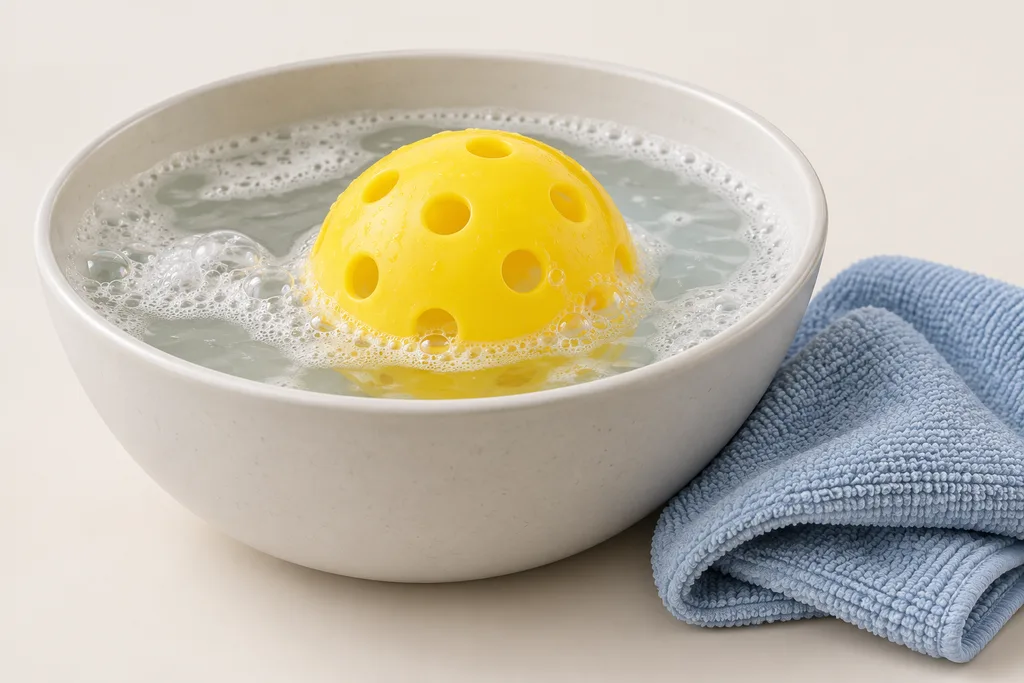
The article “Cleaning a Pickleball: The Gentle Method, Step by Step” opens here, with carefully weighed terms and clear distinctions. You'll learn to clean your pickleballs with soapy water without damaging the plastic. Each part has its job in this sequence: the starting reasoning, the steps to follow, and checking your work. These lines are written for pickleball players, recreational or competitive, and for club or association managers who want to keep their balls in good shape and know when to replace them.
The Starting Reasoning
Here's the principle: below freezing (0 °C / 32 °F), pickleballs turn brittle, which makes them more prone to cracks. That benchmark anchors the rest of the page.
A point of doctrine: when it's hot, a ball gets very soft and deforms a lot. The polymer then dissipates energy through internal friction, and the ball feels slow or mushy. Repeated large deformations also raise the risk of cracks.
Another point of doctrine: a slight seam ridge is acceptable on a ball as long as it doesn't noticeably affect its flight.
The Steps to Follow
Carry out the following steps one after the other.
- Rinse the balls thoroughly and blot them dry after washing so you don't put them away damp, since storage should only happen with completely dry balls.
- To keep your stock organized, you can separate practice balls from those set aside for official matches, which saves you from sorting the whole collection before every session.
- Cleaning is a chance to inspect each ball: cracks, splits or surface wear are signs of deterioration, as is a change in bounce quality or in the sound at impact.
- Pickleball Science recommends keeping track of how you use your balls, spotting soft areas and replacing them early, especially after more than 12 games.
- Breathable storage, such as a mesh bag, is better than an airtight container for keeping your balls.
Checking Your Work
Base your decision on the following points.
- The USAPA standard requires a bounce of 30 to 34 inches on a hard surface for a ball dropped from 78 inches, and a compression of no more than 0.25 inch under a 43-pound load.
- To study the effect of temperature, Pickleball Science measured the stiffness of eight popular balls at three temperatures: about -1 °C (30 °F), 23 °C (73 °F) and 49 °C (120 °F).
- In the same test, both balls weighed 0.95 oz when new. After about 30 games, the DuraFast still weighed 0.95 oz, while the Franklin X-40 had dropped to 0.92 oz.
- Balls used in tournaments must appear on the official list of approved balls published by USA Pickleball. They must also be a uniform color with a smooth, untextured surface, and carry the manufacturer's name or logo.
Common Missteps
Here are the missteps to watch for so you don't make them.
- It's best to avoid direct sunlight when cleaning and drying the balls, because it can degrade the plastic.
- Rinse the soap off well with clean water after washing, or the balls will stay slippery.
Ball Care Routine
The cleaning, drying and storing steps to repeat to keep your balls in good shape.
- Prepare water with a mild soap: a gentle product cleans without harming the plastic.
- Soak briefly, then rub with a soft cloth: light rubbing avoids damaging the surface.
- Rinse thoroughly and blot with a towel: soap residue and leftover water are bad for preservation.
- Air-dry, out of direct sunlight: direct sun can degrade the plastic.
- Store in a ventilated container, somewhere cool and dry: a stable temperature limits deformation.
The Bottom Line in Detail
This page has taken you through the starting reasoning, the steps to follow, checking your work and common missteps. Come back to the sections you need whenever a doubt comes up.
Go further
- IFP, USA Pickleball, Pickleball Canada: Who Sets the Ball Standards? — You'll learn which organizations set the rules and which documents they rely on. Topics covered: what the readings show and the phenomenon explained.
- Storing Your Pickleballs: Heat, Cold, and Best Practices — Store your balls at the right temperature. This page is built around the rules that govern the section and the pieces to read next.
- Gear Bag Storage: Mistakes That Damage Your Pickleballs — You'll spot the storage habits that warp pickleballs. Sections covered: the reasons to understand and the common missteps.
- Indoor vs. Outdoor Pickleballs: The Differences to Know — You'll learn to choose the ball that suits your surface and your gym. Here's what you'll find, in order: what is being weighed against what.
Sources
- Pickleball Union : entretenir et ranger ses balles de pickleball: Advice on cleaning with lukewarm water and mild soap, and on storing at a stable temperature; an editorial site with affiliate links. This reference was verified on 2026-10-13.
- Pickleball Science : comment la température affecte une balle de pickleball: Stiffness measurements of eight balls at three temperatures (about -1 °C, 23 °C and 49 °C). This reference was verified on 2026-10-13.
- Règlement USA Pickleball 2025, section 2 : terrain et équipement: Restatement of the rulebook: 26 to 40 holes, smooth surface, uniform color, ball listed as approved in sanctioned tournaments. This reference was verified on 2026-10-13.
- Pickleball Science : usure et perte de raideur d'une balle Franklin X-40: Stiffness measurement of a new ball, then after one and two hours of play. This reference was verified on 2026-10-13.
- Pickleball Science : raideur et norme USAPA: Stiffness of a new ball and after eight games, and the maximum displacement set by the USAPA standard. This reference was verified on 2026-10-13.
- Pickleball Science : comparaison Onix DuraFast 40 et Franklin X-40: Measurements of stiffness and weight, plus microscope inspection: how stiffness changed and cracks around the holes after about 32 games. This reference was verified on 2026-10-13.
Sources and Verification.
- This article cites 6 sources: 4 scientific publications.
- Facts last checked against their sources: October 13, 2026.
- How sources are chosen and verified: Editorial Principles.